
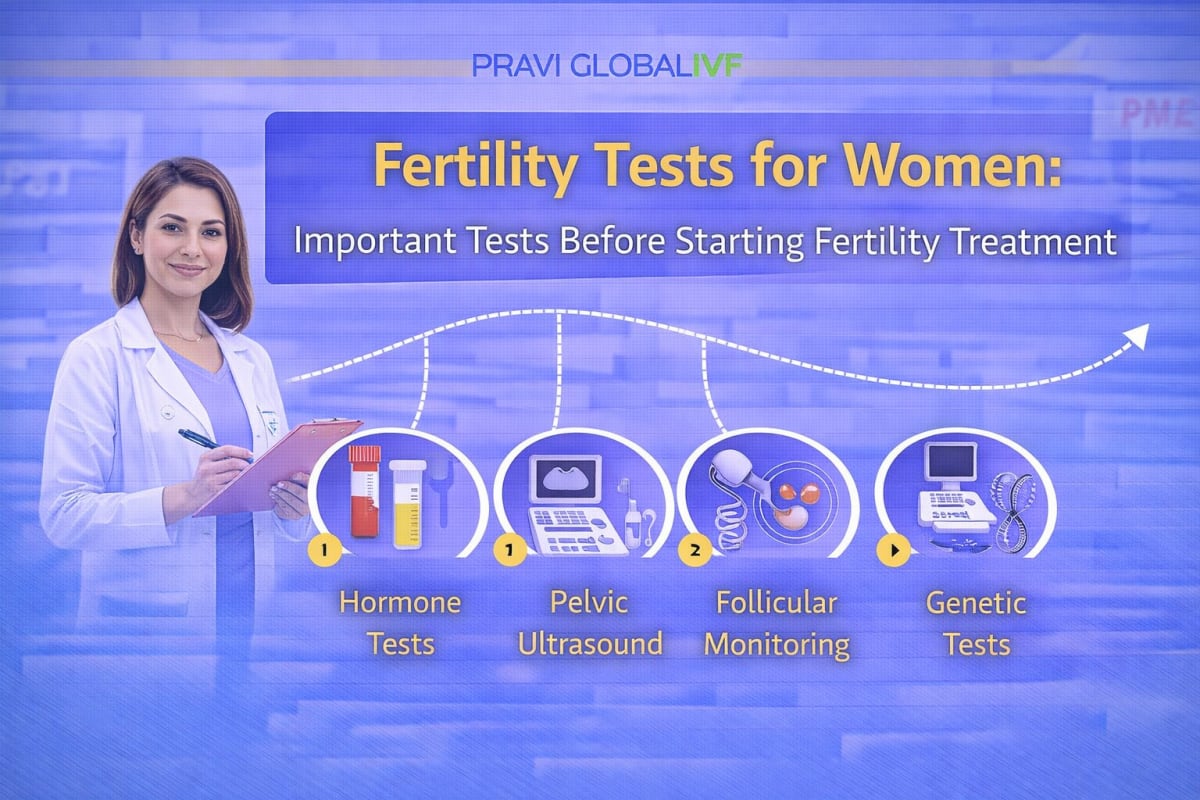
Fertility Tests for Women: Important Tests Before Starting Fertility Treatment
When a couple begins trying for a baby, they often expect pregnancy to happen naturally within a few months. But if pregnancy does not occur even after several months of trying, doctors may recommend fertility testing.
For women, fertility testing helps understand how well the reproductive system is functioning and whether there are any underlying conditions affecting conception.
These tests are not meant to create worry — they are designed to identify potential issues early and guide the right treatment plan.
Understanding the common fertility tests for women can help patients feel more prepared and confident about the evaluation process.
When Should Women Consider Fertility Testing?
Doctors generally recommend fertility evaluation when:
-
Pregnancy has not occurred after 12 months of trying
-
Women above 35 years have tried for 6 months without success
-
Menstrual cycles are irregular
-
There is a history of miscarriage
-
There are known reproductive conditions such as PCOS or endometriosis
Early testing helps identify the cause of infertility and improves treatment outcomes.
Common Fertility Tests for Women
Several tests may be used to evaluate female fertility. Each test provides important information about different aspects of reproductive health.
AMH Test (Anti-Müllerian Hormone)
The AMH test measures ovarian reserve, which indicates the number of eggs remaining in the ovaries.
AMH levels help doctors understand:
-
Egg reserve
-
Ovarian response to fertility treatment
-
Future fertility potential
The AMH test can be done at any time during the menstrual cycle.
Hormone Blood Tests
Hormonal balance plays a crucial role in ovulation and fertility.
Doctors may test hormones such as:
-
FSH (Follicle Stimulating Hormone)
-
LH (Luteinizing Hormone)
-
Estradiol
-
Prolactin
-
Thyroid hormones
These tests help determine whether ovulation is occurring normally.
Pelvic Ultrasound
Ultrasound is used to examine the uterus and ovaries.
It helps detect:
-
Ovarian follicles
-
Uterine abnormalities
-
Fibroids or cysts
-
Endometrial thickness
Ultrasound also helps monitor ovulation and follicle growth during fertility treatment.
HSG Test (Hysterosalpingography)
The HSG test checks whether the fallopian tubes are open or blocked.
During this test, a special dye is injected into the uterus and X-ray images are taken to observe the flow through the fallopian tubes.
Blocked fallopian tubes can prevent sperm from reaching the egg.
Ovulation Monitoring
Ovulation monitoring involves tracking follicle growth using ultrasound scans during the menstrual cycle.
This helps doctors determine:
-
Whether ovulation is occurring
-
The timing of ovulation
-
The health of developing follicles
Ovulation monitoring is often used when couples are planning timed intercourse or fertility treatments like IUI.
Why Fertility Testing Is Important
Fertility tests provide valuable insights into reproductive health.
They help doctors:
-
Identify possible fertility issues
-
Recommend the most appropriate treatment
-
Avoid unnecessary delays in treatment
-
Improve the chances of successful pregnancy
Proper diagnosis is the first step toward effective fertility care.
Fertility Testing for Both Partners
It is important to remember that infertility may involve both partners.
Along with female fertility tests, doctors usually recommend semen analysis to evaluate male fertility as well.
Evaluating both partners helps provide a complete understanding of the situation.
Why Delhi Is a Preferred City for Fertility Testing
Delhi offers advanced diagnostic facilities and experienced fertility specialists who can accurately evaluate reproductive health.
Clinics such as PRAVI Global IVF Polyclinic provide comprehensive fertility assessments and guide couples through the next steps in their treatment journey.
A Final Thought
Fertility testing is not something to fear. Instead, it is a valuable step toward understanding your reproductive health.
With accurate diagnosis and timely medical guidance, many couples successfully overcome fertility challenges and achieve pregnancy.
Contact Details
PRAVI Global IVF Polyclinic — Lajpat Nagar, Delhi
41, First Floor, Ring Road
Block Q, Lajpat Nagar IV, New Delhi – 110024
Phone: +91 80091 50040
Email: info@praviglobalivf.in
Ready to Start Your Fertility Journey?
Our experienced team at Pravi IVF is here to support you every step of the way