
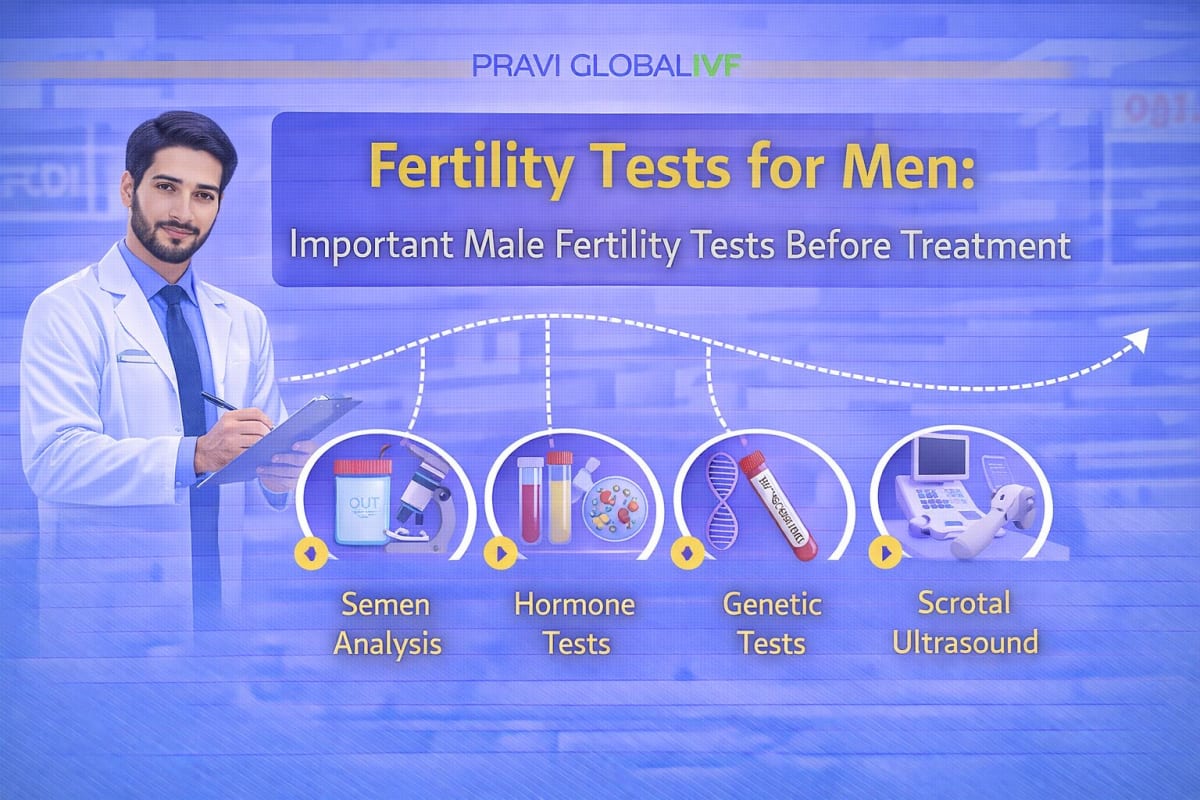
Fertility Tests for Men: Important Male Fertility Tests Before Treatment
When couples face difficulty conceiving, many people initially focus only on female fertility. However, medical research shows that male factors contribute to nearly half of infertility cases.
Because of this, fertility specialists usually recommend evaluating both partners at the same time.
Male fertility testing helps doctors understand whether sperm production, hormone levels, and reproductive health are functioning normally. These tests provide important information that helps determine the most effective treatment plan.
Understanding the common fertility tests for men can help couples approach fertility evaluation with clarity and confidence.
When Should Men Consider Fertility Testing?
Men may be advised to undergo fertility testing when:
-
Pregnancy has not occurred after 12 months of trying
-
The female partner is over 35 and pregnancy has not occurred after 6 months
-
There is a history of reproductive health issues
-
Previous semen analysis showed abnormal results
-
There has been testicular injury or surgery
Early testing helps detect potential problems and guide treatment decisions sooner.
Semen Analysis
The semen analysis is the most important fertility test for men.
This test evaluates several key sperm parameters, including:
-
Sperm count (number of sperm present)
-
Sperm motility (ability of sperm to swim)
-
Sperm morphology (shape of sperm)
-
Semen volume
A healthy semen sample improves the chances of sperm reaching and fertilizing the egg.
If abnormal results appear, the test may be repeated to confirm the findings.
Hormone Blood Tests
Hormones play an important role in sperm production.
Blood tests may be used to measure hormones such as:
-
Testosterone
-
Follicle Stimulating Hormone (FSH)
-
Luteinizing Hormone (LH)
-
Prolactin
Hormonal imbalances may interfere with sperm production and fertility.
Scrotal Ultrasound
A scrotal ultrasound helps doctors examine the testicles and surrounding structures.
This imaging test may detect conditions such as:
-
Varicocele (enlarged veins in the scrotum)
-
Testicular abnormalities
-
Blockages in sperm transport pathways
These conditions may affect sperm production or movement.
Genetic Testing
In cases of very low sperm count or absent sperm, doctors may recommend genetic testing.
Genetic tests help identify conditions that may affect sperm production or reproductive health.
Understanding genetic factors can guide appropriate fertility treatment.
Sperm DNA Fragmentation Test
Sometimes semen analysis appears normal, but sperm DNA quality may still be affected.
A sperm DNA fragmentation test measures the level of DNA damage in sperm cells.
High DNA fragmentation may reduce fertilization rates and affect embryo development.
Why Male Fertility Testing Is Important
Male fertility tests help doctors:
-
Identify the cause of infertility
-
Determine whether sperm production is healthy
-
Select the most appropriate fertility treatment
Proper diagnosis ensures that couples receive the most effective treatment rather than unnecessary procedures.
Treatment Options After Diagnosis
Treatment for male infertility depends on the specific cause identified during testing.
Possible treatment options may include:
-
Lifestyle modifications
-
Medical treatment for hormonal imbalance
-
Surgical correction of conditions such as varicocele
-
Assisted reproductive techniques such as IUI, IVF, or ICSI
Modern fertility treatments have helped many couples overcome male infertility challenges.
Why Delhi Is a Trusted City for Male Fertility Evaluation
Delhi offers advanced fertility diagnostics and experienced fertility specialists who evaluate both male and female reproductive health.
Clinics such as PRAVI Global IVF Polyclinic provide comprehensive fertility assessments and modern treatment options tailored to each couple’s condition.
A Final Thought
Male fertility testing is a simple but important step in understanding infertility.
By evaluating both partners early, doctors can identify potential issues and guide couples toward the most effective treatment options.
With the right diagnosis and medical support, many couples successfully achieve pregnancy.
Contact Details
PRAVI Global IVF Polyclinic — Lajpat Nagar, Delhi
41, First Floor, Ring Road
Block Q, Lajpat Nagar IV, New Delhi – 110024
Phone: +91 80091 50040
Email: info@praviglobalivf.in
Ready to Start Your Fertility Journey?
Our experienced team at Pravi IVF is here to support you every step of the way