
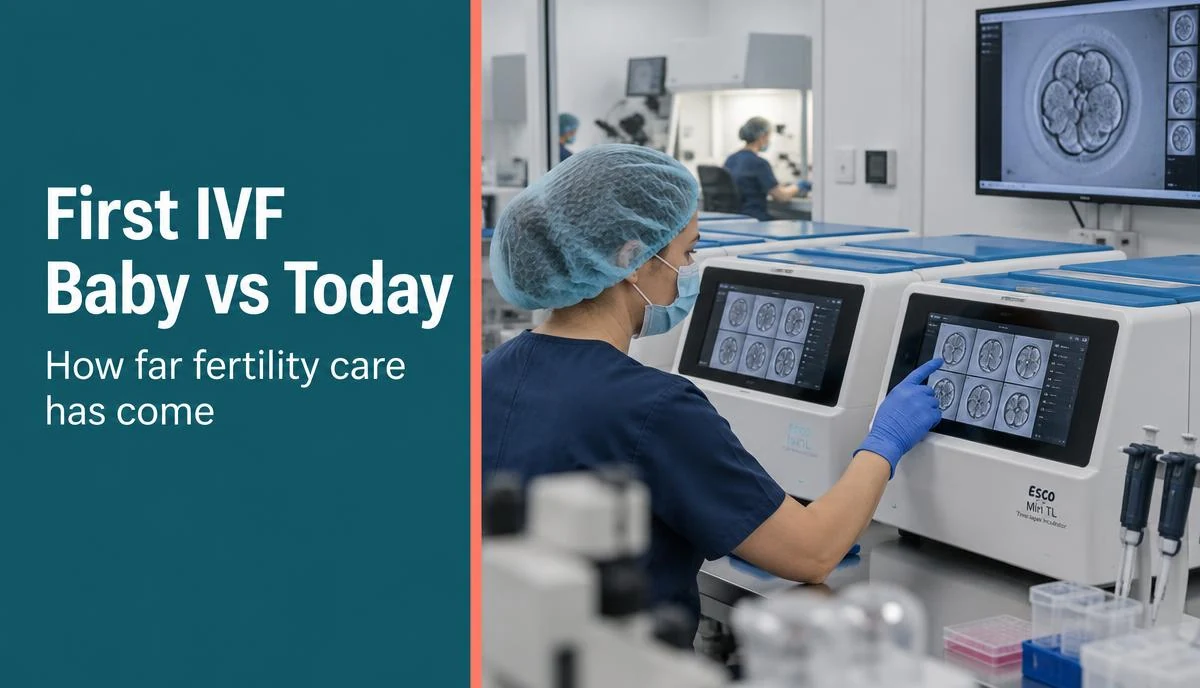
In July 1978, the birth of Louise Joy Brown made headlines worldwide. As the world's first child conceived through In Vitro Fertilization (IVF), she was famously labeled a "test tube baby." Her birth was a historic breakthrough, but the process used to conceive her was worlds away from the fertility care patients receive today.
Comparing the first IVF baby vs modern IVF highlights the incredible clinical progress, safety enhancements, and laboratory developments that have occurred over the last four decades. What was once an experimental, low-probability procedure has evolved into a highly successful, mainstream medical specialty.
The 1978 Milestone: Louise Brown's Conception
Louise Brown was conceived through the collaboration of gynecologist Patrick Steptoe and physiologist Robert Edwards. The clinical approach in 1978 was characterized by simplicity and high risk:
- Natural Menstrual Cycle: The team did not use stimulation medications. They monitored the natural cycle and retrieved the single egg she produced.
- Laparoscopic Retrieval: Egg retrieval was a major surgery performed under general anesthesia using a laparoscope.
- High Failure Rates: It took 102 failed attempts in different patients before Louise Brown was successfully conceived and carried to term.
How Modern IVF Has Transformed Fertility Care
1. Controlled Stimulation and Multiple Eggs
Modern protocols use customized hormone injections to stimulate the ovaries to produce multiple eggs (typically 8 to 15) in a single cycle, dramatically increasing the chance of success per cycle.
2. Minimally Invasive Egg Retrieval
Egg retrieval is now an outpatient procedure performed under light sedation. Guided by a transvaginal ultrasound, the doctor retrieves eggs in about 15 minutes, and patients return home the same day.
3. Intracytoplasmic Sperm Injection (ICSI)
Conventional IVF requires high-quality sperm. Today, embryologists use ICSI to select a single healthy sperm cell and inject it directly into the egg, resolving even the most severe male infertility cases. Read more about this in our guide to IVF treatment in Lajpat Nagar Delhi.
4. Advanced Embryo Freezing (Vitrification)
Modern vitrification ("flash freezing") allows clinics to store eggs and embryos indefinitely with survival rates exceeding 95% upon thawing, enabling planned frozen embryo transfers (FET).
Experience Advanced Fertility Care
Modern IVF is personalized, safe, and built on world-class laboratory standards. If you want to discuss your path to parenthood, you can book a consultation with a specialist at Pravi Global IVF.
Side-by-Side Comparison: Then vs. Now
| Metric | Louise Brown's IVF (1978) | Modern IVF (Present Day) |
|---|---|---|
| Number of Eggs | 1 (natural cycle). | 8 to 15 (stimulated cycle). |
| Retrieval Method | Laparoscopic surgery, general anesthesia. | Transvaginal ultrasound needle, light sedation. |
| Embryo Storage | None (cryopreservation did not exist). | Vitrification (>95% survival). |
| Genetic Testing | None. | PGT-A chromosomal screening. |
| Average Success Rate | Less than 1% per attempt in 1970s. | Up to 50% - 60% per transfer in ideal cases. |
Frequently Asked Questions
1. Are IVF babies born today as healthy as Louise Brown?
Yes. Louise Brown has grown up healthy, conceived her children naturally, and is now in her late 40s. Millions of children born via IVF worldwide have been tracked, confirming they are as healthy as naturally conceived children.
2. Why is Single Embryo Transfer (eSET) preferred today?
In the past, clinics transferred multiple embryos, leading to dangerous twin or triplet pregnancies. Today, transferring a single healthy embryo maintains high success rates while eliminating the risks of multiple births.
Conclusion
The comparison between the first IVF baby vs modern IVF shows the incredible speed of medical progress. What was once a rare scientific experiment has become a reliable, everyday treatment that has brought joy to millions of families.
At Pravi Global IVF, we are proud to offer the latest advancements in embryology and fertility care. Contact Pravi Global IVF today to schedule a consultation with our experienced clinical team.

Medical Reviewer
Dr. Monica Sachdev
Dr. Monica Sachdev is a leading IVF specialist in Delhi with over 18 years of experience in reproductive medicine. She is dedicated to providing evidence-based fertility care and has helped thousands of families achieve parenthood.
Ready to Start Your Fertility Journey?
Our friendly team at Pravi IVF is here to stand by you, listen to your story, and help you through every single step.