
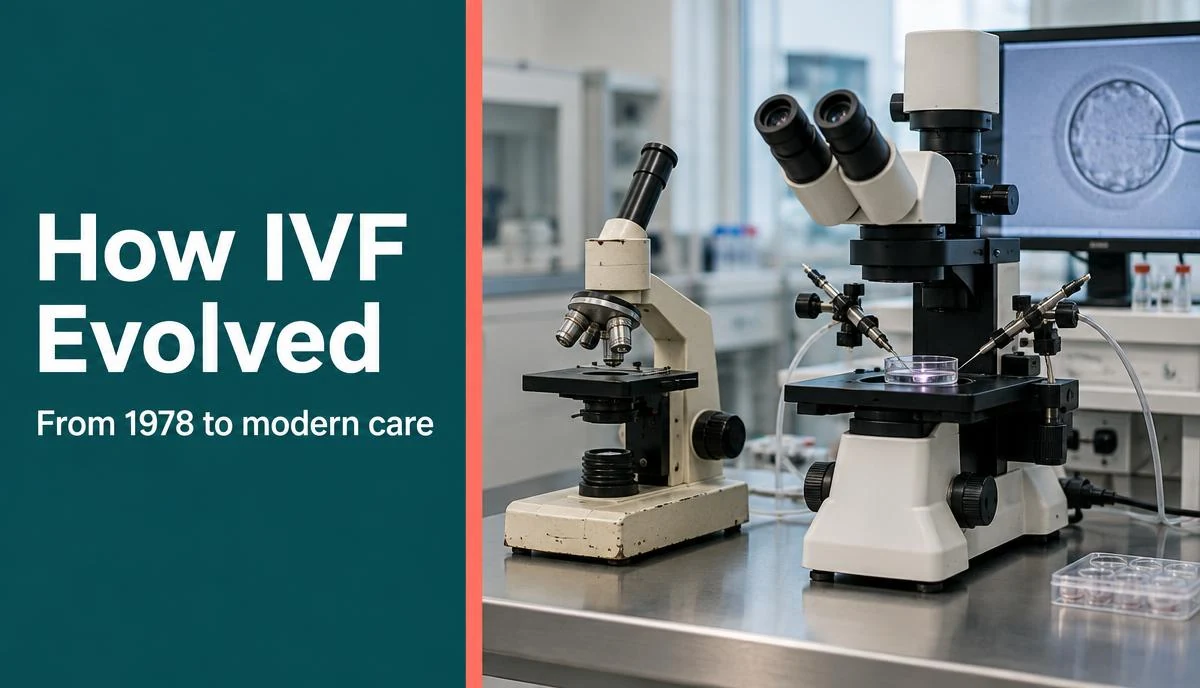
In the history of modern medicine, few developments have transformed families and reproductive health as profoundly as In Vitro Fertilization (IVF). What began as a highly experimental, widely debated procedure has grown into a standard, globally accepted medical treatment that has helped millions of couples achieve their dreams of parenthood.
The evolution of IVF treatment is a story of clinical persistence, technological breakthrough, and increasing safety. Tracing this journey from the birth of the first "test tube baby" in 1978 to the sophisticated, highly personalized fertility care of today helps us appreciate how far reproductive medicine has come and what the future holds for aspiring parents.
The Beginning: The Birth of Louise Brown (1978)
The modern era of reproductive medicine began on July 25, 1978, in Oldham, England, with the birth of Louise Joy Brown. Her birth was the result of years of research and collaboration between embryologist Jean Purdy, physiologist Robert Edwards, and gynecologist Patrick Steptoe.
- Natural Cycle IVF: Louise Brown's conception did not involve fertility drugs to stimulate multiple eggs. Instead, doctors monitored the mother’s natural menstrual cycle, retrieved a single egg during ovulation, fertilized it in a laboratory dish, and transferred the embryo back to the uterus.
- Low Success Rates: Because only one egg was retrieved, the chances of a successful pregnancy were extremely low. It took hundreds of failed attempts before Louise Brown was successfully conceived.
- Public Debate: The achievement was met with both wonder and intense ethical debate. The media coined the term "test tube baby," though fertilization actually took place in a flat glass Petri dish, not a test tube.
Robert Edwards was awarded the Nobel Prize in Physiology or Medicine in 2010 for his role in developing IVF, cementing the procedure's place as a cornerstone of modern science.
The 1980s: Stimulated Cycles and Ultrasound Advancements
Following the initial success in the UK, clinics worldwide began working to make IVF a reliable, repeatable clinical procedure. The 1980s brought changes that significantly improved success rates:
1. Controlled Ovarian Stimulation (COH)
Instead of relying on a single egg from a natural cycle, doctors began using gonadotropin medications to stimulate the ovaries to produce multiple eggs. Retrieving multiple eggs gave embryologists more chances to create healthy embryos, which drastically improved success rates.
2. Transition to Transvaginal Ultrasound
In the early days, egg retrieval was a major surgical procedure that required laparoscopy under general anesthesia. In the mid-1980s, the introduction of transvaginal ultrasound-guided egg retrieval transformed the procedure. It allowed doctors to retrieve eggs using a thin needle guided by ultrasound, converting egg retrieval into a quick, minimally invasive outpatient procedure performed under light sedation.
A Legacy of Modern Fertility Care
Today, IVF treatments are safe, highly controlled, and tailored to your specific hormonal profile. If you want to explore how modern protocols can help you, you can schedule a consultation with the clinical experts at Pravi Global IVF.
The 1990s: ICSI, Egg Freezing, and Early Genetic Screening
The 1990s brought some of the most critical breakthroughs in the evolution of IVF treatment, opening doors for couples who previously had no treatment options.
1. Intracytoplasmic Sperm Injection (ICSI)
In 1992, researchers in Belgium developed ICSI. Before ICSI, conventional IVF required thousands of active sperm cells to fertilize an egg in a dish. If a man had severe male factor infertility (low sperm count or poor motility), fertilization was unlikely to occur. ICSI changed this by allowing embryologists to select a single healthy sperm cell and inject it directly into the egg, resolving severe male infertility issues.
2. Introduction of PGD (Preimplantation Genetic Diagnosis)
The late 1990s saw the first successful use of Preimplantation Genetic Diagnosis (PGD). This technology allowed embryologists to test cells from an embryo to check for specific inherited genetic disorders (like cystic fibrosis or thalassemia) before transferring the embryo, ensuring that children did not inherit debilitating diseases.
The 2000s to Present: Refined Selection, Vitrification, and AI
In the 21st century, the focus of reproductive medicine shifted from simply achieving pregnancy to optimizing safety, reducing multiple pregnancies (twins/triplets), and improving the comfort of the patient.
1. Vitrification (Flash Freezing)
Early slow-freezing methods for embryos and eggs often led to the formation of ice crystals, which could damage delicate cell walls. The development of vitrification—an ultra-rapid "flash freezing" technique—revolutionized cryopreservation. Today, frozen embryo transfers (FET) have survival rates exceeding 95% and success rates that equal or exceed fresh embryo transfers.
2. Single Embryo Transfer (SET)
In the early decades, clinics routinely transferred multiple embryos (often 3 or 4) to maximize the chances of at least one implanting. This resulted in high rates of multiple pregnancies, which carry severe risks for both the mother and babies. Thanks to improved laboratory environments and selection techniques, clinics now practice Single Embryo Transfer (SET) as a standard, ensuring safe, healthy, single pregnancies.
3. PGT-A (Aneuploidy Screening)
Modern Preimplantation Genetic Testing for Aneuploidies (PGT-A) allows doctors to screen embryos for numerical chromosomal abnormalities before transfer. This ensures that only chromosomally normal (euploid) embryos are selected, which significantly reduces miscarriage rates and shortens the time to a successful pregnancy. Learn more about advanced screening options in our guide to PGS/PGD testing in Delhi.
Comparing the Eras: Early IVF vs. Modern IVF
| Feature | Early IVF (Late 1970s / 1980s) | Modern IVF (Present Day) |
|---|---|---|
| Egg Stimulation | Natural cycles (1 egg) or basic stimulation. | Highly personalized, hormone-matched protocols. |
| Egg Retrieval Method | Laparoscopic surgery under general anesthesia. | Minimally invasive transvaginal needle under light sedation. |
| Fertilization Method | Conventional mix in a dish. | Conventional IVF or ICSI (single sperm injection). |
| Embryo Selection | Visual assessment under a microscope. | PGT-A genetic screening and Time-Lapse incubators. |
| Cryopreservation | Experimental; low embryo survival rates. | Vitrification (exceeding 95% survival rates). |
| Embryos Transferred | Multiple (3 to 4), resulting in high twin/triplet rates. | Elective Single Embryo Transfer (eSET). |
Frequently Asked Questions
1. Why are modern IVF success rates higher than in the past?
Modern success rates are higher because of improvements in laboratory equipment, culture media that mimic the fallopian tubes, advanced genetic testing (PGT-A), and flash-freezing (vitrification) techniques that allow for better timing of embryo transfers.
2. What is the difference between conventional IVF and ICSI?
In conventional IVF, eggs and sperm are placed together in a laboratory dish to fertilize naturally. In ICSI, an embryologist selects a single healthy sperm cell and injects it directly into the egg, which bypasses male factor barriers.
3. Are IVF babies as healthy as naturally conceived babies?
Yes. Decades of clinical tracking of millions of children born via IVF have shown that they are as healthy, develop normally, and grow up just like children conceived naturally.
4. How has the patient experience of IVF improved?
Modern IVF uses low-dose, tailored hormone protocols (like antagonist protocols) that minimize side effects and reduce the risk of Ovarian Hyperstimulation Syndrome (OHSS).
5. What is the next major step in the evolution of IVF?
The next phase in reproductive medicine involves the integration of Artificial Intelligence (AI) to evaluate embryo quality, automated time-lapse monitoring of embryo growth, and improved non-invasive genetic testing methods.
Conclusion
The evolution of IVF treatment has turned an experimental scientific hope into a reliable, mainstream medical procedure. As technologies like vitrification, ICSI, and genetic testing continue to improve, fertility treatments become safer, more comfortable, and more successful for couples seeking to build their families.
At Pravi Global IVF, we combine warm, compassionate patient care with state-of-the-art laboratory standards to give you the best path to success. Contact Pravi Global IVF today to discuss your options with an experienced specialist.

Medical Reviewer
Dr. Monica Sachdev
Dr. Monica Sachdev is a leading IVF specialist in Delhi with over 18 years of experience in reproductive medicine. She is dedicated to providing evidence-based fertility care and has helped thousands of families achieve parenthood.
Ready to Start Your Fertility Journey?
Our friendly team at Pravi IVF is here to stand by you, listen to your story, and help you through every single step.