
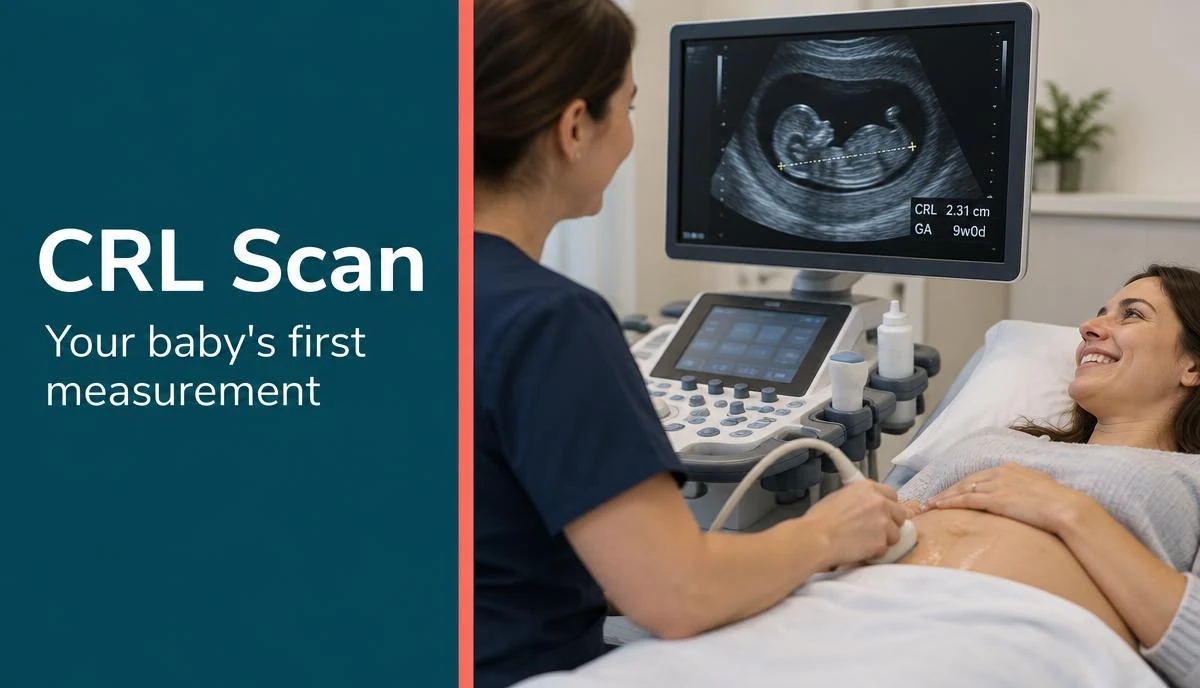
For expectant parents, the first prenatal ultrasound is a milestone filled with excitement and anticipation. During this initial scan, the sonographer or doctor will take several measurements to evaluate the pregnancy. Among these, the most crucial measurement is the Crown-Rump Length (CRL) in pregnancy.
If you have recently looked at your first-trimester scan report, you likely saw the letters "CRL" followed by a number in millimeters. Understanding what CRL is, how it is calculated, and why it is so important during early pregnancy can give you peace of mind as your baby grows.
What Is Crown-Rump Length (CRL)?
Crown-Rump Length is the measurement of the length of human embryos and fetuses from the top of the head (crown) to the bottom of the buttocks (rump).
Crucially, this measurement does not include the yolk sac or the baby’s limbs (legs and arms). In the early stages of development, the embryo's legs are curled up, making it difficult to measure the baby from head to toe. Measuring from the head to the buttocks provides a consistent, straight-line measurement that closely correlates with gestational development.
Why Is CRL Measured?
The first trimester is a period of rapid and highly predictable fetal growth. Because embryos grow at a very uniform rate during these early weeks, CRL is the most accurate tool available for evaluating a pregnancy.
1. Determining the Gestational Age (Pregnancy Dating)
Many women do not have regular 28-day menstrual cycles, or they may not remember the exact date of their last menstrual period (LMP). In these situations, using LMP to calculate how far along the pregnancy is can lead to errors. Measuring the CRL between the 6th and 14th week of pregnancy allows doctors to determine the baby's gestational age with an accuracy of within 3 to 5 days.
2. Estimating the Due Date (EDD)
Your estimated due date (EDD) is calculated based on the gestational age. If there is a discrepancy of more than 7 days between the due date calculated by your last period and the due date calculated by the early ultrasound CRL, the doctor will adjust your due date to match the ultrasound findings.
3. Monitoring Early Growth and Development
A CRL scan confirms that the pregnancy is growing inside the uterus as expected. It helps doctors confirm:
- Fetal viability (by checking for a heartbeat next to the embryo)
- Whether it is a single pregnancy or multiples (twins/triplets)
- Healthy developmental milestones matching the expected timeline
Planning a Healthy Pregnancy
Getting accurate assessments in early pregnancy is a key part of prenatal care. If you are early in your pregnancy or preparing for a dating scan, you can book a consultation at Pravi Global IVF to ensure your pregnancy is progressing smoothly.
How Is CRL Measured?
CRL is measured using high-resolution ultrasound imaging. The timing of the scan is critical to obtaining an accurate reading.
1. Timing of the Scan (First Trimester)
CRL measurements are only taken during the first trimester, typically between 6 weeks and 13 weeks + 6 days of pregnancy.
- Before 6 weeks: The embryo is too small to be measured accurately.
- After 14 weeks: The baby begins to stretch, bend, and move, which changes the measurement. At this stage, doctors transition to other measurements.
2. Performing the Ultrasound (TVS vs. Abdominal)
Depending on how early you are in your pregnancy, the ultrasound may be performed in one of two ways:
- Transvaginal Ultrasound (TVS): Typically used in very early pregnancy (before 8 weeks). A small probe is inserted into the vagina, providing clear, close-up images of the tiny gestational sac. Learn more about pelvic diagnostics by checking our guide on PCOS treatment in Delhi.
- Transabdominal Ultrasound: Used later in the first trimester (after 9 weeks). Gel is applied to your lower abdomen, and a transducer is moved across the skin.
3. Measuring from Crown to Rump
The sonographer freezes the ultrasound image when the embryo is in a neutral position (not flexed or hyperextended). They then place electronic markers on the screen at the top of the head and the bottom of the buttocks. The computer calculates the distance in millimeters, which translates to a specific gestational age in weeks and days.
What Do CRL Measurement Results Mean?
To help you understand your scan results, here is a general guide to typical CRL measurements by week during the first trimester:
| Gestational Age (Weeks) | Typical CRL Measurement (Approximate Range) | Fetal Development Milestone |
|---|---|---|
| 6 Weeks | 4 – 9 mm | Fetal pole becomes visible; heartbeat can be detected |
| 8 Weeks | 15 – 22 mm | Brain vesicles forming; tiny limb buds appear |
| 10 Weeks | 31 – 40 mm | Embryo becomes a fetus; fingers and toes start developing |
| 12 Weeks | 54 – 69 mm | Face is well-formed; active movements begin |
| 13 Weeks + 6 Days | 80 – 85 mm | Final window for CRL measurement |
What if the CRL Is Different Than Expected?
It is common for the ultrasound gestational age to differ slightly from your calculations. If the CRL is smaller or larger than expected, it could mean:
- Incorrect Conception Date: You may have ovulated later or earlier in your cycle than you thought. This is the most common reason for a discrepancy.
- Early Growth Variation: Sometimes, early growth can vary slightly. A follow-up scan in 7 to 10 days is often recommended to verify that the baby is growing at a healthy rate.
CRL in IVF Pregnancies
In pregnancies achieved through In Vitro Fertilization (IVF), the date of conception is known exactly (the day of egg retrieval or embryo transfer). Because of this, the gestational age is fixed and does not change based on ultrasound measurements.
However, measuring CRL in IVF pregnancies is still highly valuable. It serves as an early indicator of fetal health and growth consistency. If you want to understand how IVF progress is monitored, read our detailed overview of IVF treatment.
Frequently Asked Questions
1. What is a normal CRL at 8 weeks?
At 8 weeks of pregnancy, a normal Crown-Rump Length is typically between 15 mm and 22 mm. At this stage, you will also be able to see the yolk sac and a clear heartbeat on the ultrasound screen.
2. Can CRL predict the gender of the baby?
No. Crown-Rump Length only measures the physical length of the baby to determine growth and age. Fetal sex organs are not developed enough in the first trimester to be identified by CRL.
3. What does it mean if the CRL is small but there is a heartbeat?
If the CRL is smaller than your calculations suggest but a strong heartbeat is present, it usually means your ovulation date was later than estimated. Your doctor will likely adjust your due date based on the CRL measurement.
4. Is the CRL scan safe for the baby?
Yes. Prenatal ultrasounds use high-frequency sound waves, not radiation, to create images of the uterus. Decades of clinical use have shown that routine diagnostic ultrasounds are safe for both the mother and the developing baby.
5. Why is CRL not measured after 14 weeks?
After 14 weeks, the baby's body becomes more flexible, allowing them to stretch and curl. This movement makes a crown-to-rump measurement inconsistent. Doctors then switch to measuring individual parts, such as the head, abdomen, and thigh bone.
Conclusion
The Crown-Rump Length (CRL) in pregnancy is a vital marker that helps healthcare providers establish a reliable timeline for your pregnancy. By providing an accurate gestational age and estimated due date, the CRL scan ensures that all subsequent prenatal care, growth tracking, and screening tests are scheduled at the correct times.
If you are planning your pregnancy or seeking expert prenatal evaluation, having a trusted medical team is essential. Contact Pravi Global IVF today to schedule your dating scan and discuss your pregnancy journey.

Medical Reviewer
Dr. Monica Sachdev
Dr. Monica Sachdev is a leading IVF specialist in Delhi with over 18 years of experience in reproductive medicine. She is dedicated to providing evidence-based fertility care and has helped thousands of families achieve parenthood.
Ready to Start Your Fertility Journey?
Our friendly team at Pravi IVF is here to stand by you, listen to your story, and help you through every single step.