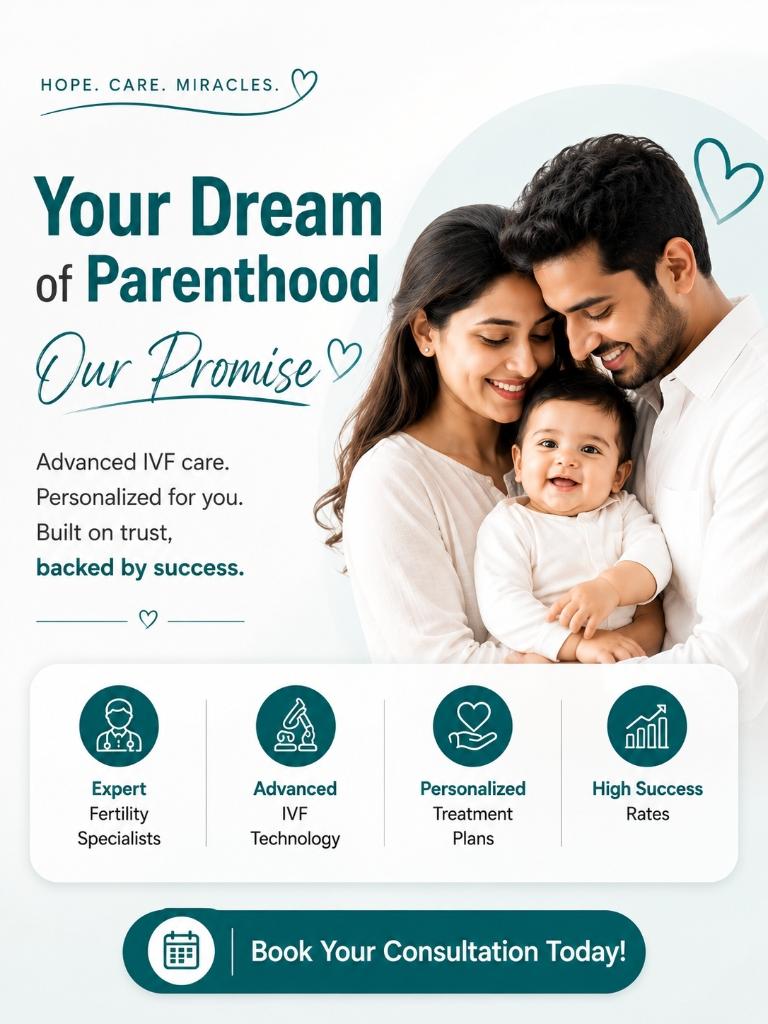

माता-पिता बनने का सपना होगा पूरा,
एडवांस्ड IVF केयर के साथ
Clinical Feed
Sample verified #EWS-492
Environment optimal: 37°C / 37% RH
Next priority slot in 12 mins
Book Free Advisory
Skip the waiting room. Provide your details below to reserve an exclusive, confidential doctor consultation.
Personalized Score
Complete this 4-step clinical questionnaire to intelligently estimate your fertility success probability based on robust clinic data.
Q1: What is the age of the female partner?
Clinical Treatments
In-Vitro Fertilization (IVF)
"World-Class Assisted Reproductive Technology"
Our advanced IVF treatment utilizes customized stimulation protocols and state-of-the-art laboratory standards to achieve success even in complex cases.
Key Advantages
Treatment Timeline
Ovarian Stimulation
Standard Protocol
Egg Retrieval
Standard Protocol
Fertilization in Lab
Standard Protocol
Embryo Culture
Standard Protocol
Precision Embryo Transfer
Standard Protocol
Reserve a Session
1. Select Specialist
Success Stories
"5 saal ki koshish aur har jagah se nirasha ke baad, hum Pravi IVF aaye. Yahan advanced tech aur doctor ke support se aaj hamare ghar me twin baby girls ki kilkariyan goonj rahi hain."